
From wafer-handling systems to rack-mounted test gear and control cabinets, the “brains” may be silicon—but the reliability often comes down to the metalwork around it: rigid structures, clean interfaces, thermal paths, shielding, and serviceable access.
Why Metal Parts Matter
Metal components do more than “hold things together.” They create stiffness and alignment for precision assemblies, provide grounding paths, manage heat, reduce EMI/RFI leakage, and protect sensitive components from handling and the environment.
Structural Performance and Alignment
Rigid metal structures maintain alignment for PCBs, connectors, optics, and moving subsystems. In precision equipment, small deflections can translate into performance drift or assembly challenges.
Electrical Grounding and Shielding
Properly designed metal parts create consistent grounding paths and shielding surfaces that help control electromagnetic interference in dense electronic systems. Neutral electrical safety information is available through OSHA.
Thermal and Environmental Protection
Metal enclosures and plates also serve as thermal paths, helping move heat away from sensitive components while protecting assemblies from handling damage and environmental exposure.
Material Selection for Semiconductor Devices
In contamination-sensitive applications, material selection and finishing can support cleanliness and corrosion resistance expectations common in semiconductor devices.
Cleanliness and Corrosion Considerations
Smooth surfaces, appropriate finishes, and corrosion-resistant materials help reduce particle generation and simplify cleaning in controlled environments.
Standards and Manufacturing Context
Material and finishing choices can be considered alongside manufacturing information from NIST MEP, SME, and ISO.
Common Materials and Finishes
Most assemblies blend a few go-to materials with finishes chosen for conductivity, corrosion resistance, appearance, and cleanability.
Common Materials
- Aluminum: lightweight, machinable, excellent for thermal management; often anodized
- Stainless steel: corrosion resistance, cleanability; common in harsh or clean environments
- Cold-rolled or galvanized steel: rigidity and cost effectiveness for cabinets and frames
- Copper in select cases: high thermal conductivity for heat spreaders and thermal parts
Typical Finishes
Common finishes include anodizing, passivation, plating, and powder coating and finishing, selected based on where the part lives, whether conductivity matters, and how it will be cleaned or handled.
10 Metal Components Used With Semiconductor Devices
These components show up across board-level electronics, test systems, and semiconductor devices, with each performing a specific structural, thermal, electrical, or protective role.
1. Sheet Metal Enclosures and Instrument Housings
These protect electronics, provide mounting, and create grounding and shielding surfaces.
- Watch for: bend radii, PEM hardware placement, door and cover seams, gasket lands
- Common materials: aluminum, CRS, stainless
For control boxes and bench instruments, custom electronic enclosures can provide the required protective structure.
2. Chassis and Subchassis
Chassis parts act like the “skeleton” inside a product, holding PCBs, PSUs, fans, and connectors in precise alignment.
- Watch for: datum strategy, fastener access, serviceability, tolerance stack-up
- Common processes: laser cutting, forming, and hardware insertion
Electronic chassis can support these internal assemblies.
3. Mounting Brackets and Standoff Plates
Simple parts can have a large impact because they control alignment, strain relief, and assembly speed.
- Watch for: hole-to-edge distances, slot use for adjustability, deburring requirements
- Design bracket families with consistent thickness and material where practical
4. Front Panels and Operator Interfaces
Front panels carry branding, labeling, cutouts for displays and switches, and often define perceived quality.
- Watch for: cosmetic surface requirements, countersinks, legends, graphics, and edge quality
- Consider anodize with laser marking or powder coat with silk screening depending on use case
5. EMI/RFI Shielding Panels
Metal enclosures and partitions can reduce electromagnetic interference by forming conductive barriers, especially when seams and openings are treated correctly.
- Watch for: conductivity across joints, coating choices, gasket compression
- Common add-ons: conductive gaskets, fingerstock, bonded lids and doors
6. Heat Sinks and Thermal Mounting Plates
Thermal parts move heat away from hot devices into air or liquid cooling paths, improving reliability and performance.
- Watch for: flatness, surface contact, mounting pattern, airflow direction
- Common materials: aluminum and copper
7. Card Guides and PCB Retainers
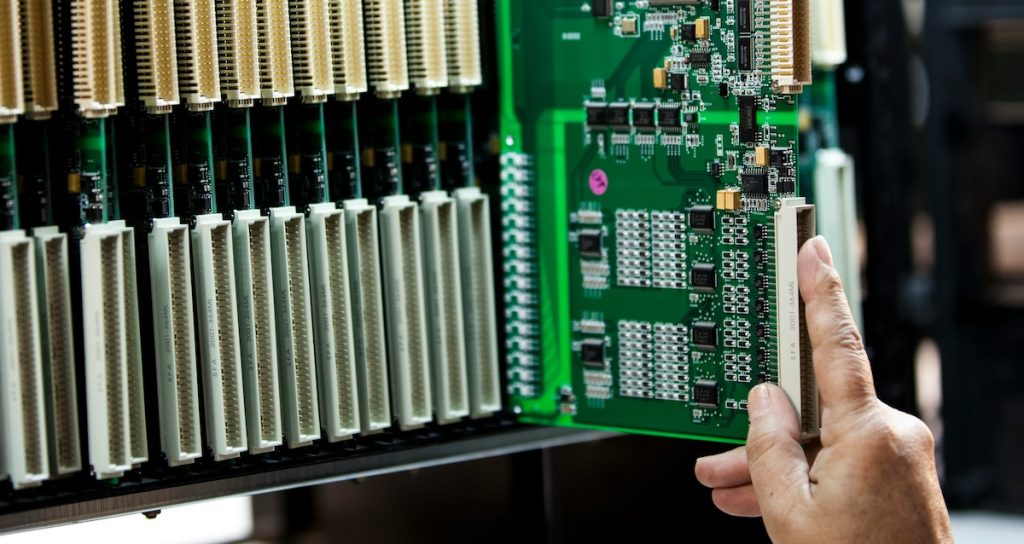
Especially in rack systems and test equipment, guides and cages keep cards aligned, protected, and serviceable around semiconductor devices.
- Watch for: insertion and removal ergonomics, tolerances for rail spacing, wear points
- Consider grounding fingers or bonding where EMI control is important
8. Backplates and Stiffeners
These increase rigidity, control vibration, and provide consistent datum surfaces for repeatable assembly.
- Watch for: thickness versus weight tradeoffs, fastener pull-through, flatness targets
9. Cable Management Hardware
Cables are a failure mode when ignored. Strain relief and routing improve reliability and serviceability.
- Watch for: bend radius, connector clearance, tie-down locations, sharp-edge mitigation
- Add edge grommets, cable clamps, and protected pass-throughs where needed
10. Frames, Cabinets, and Equipment Covers
For semiconductor devices, metalwork often extends beyond the “box” into larger structural and protective assemblies.
- Watch for: cleanable geometries, corrosion resistance, repeatable alignment features
- Common materials: stainless steel and anodized aluminum
Designing Better Metal Components
Parts used around semiconductor devices should be considered as part of the complete assembly rather than isolated components.
What to Figure Out Early
- Specify functional requirements first, including cosmetic faces, sealing, grounding, and flatness
- Use consistent thicknesses and materials across a family of parts
- Leave room for hardware tools and service access
- Call out deburr and edge-break expectations clearly
- Define contact areas and acceptable coatings for thermal and shielding parts
Align on Manufacturing Capabilities
For quoting and manufacturability discussions, it helps to align early on process capabilities such as laser cutting, CNC machining, and fabrication assembly.
Supporting Semiconductor Equipment
If a product needs tight, repeatable metal parts—enclosures, chassis, brackets, thermal components, frames, or cleanroom-adjacent assemblies—Eagle Metalcraft supports electronics and semiconductor customers.
Precision Fabrication
Semiconductor fabrication capabilities support metal components surrounding semiconductor devices and related equipment.
Additional neutral information about semiconductor technology is available through NIST semiconductor resources.
FAQ
These are common questions when engineers are sourcing enclosures, chassis, and precision parts for semiconductor devices.
What is the difference between a chassis and an enclosure?
A chassis is typically the internal structural frame that holds components, while an enclosure is the outer protective housing. Many products use both, sometimes combined into one formed assembly.
How should EMI shielding be considered in a metal enclosure?
Continuity matters most. Conductive enclosures help block electromagnetic fields, but seams, doors, and penetrations are common leakage points.
When should aluminum or stainless steel be used?
Aluminum is lighter and supports thermal performance, while stainless offers durability, corrosion resistance, and cleanability. The choice depends on environment and handling.
Do heat sinks always need to be custom?
Not always. Standard extrusions work in many cases, but custom mounting patterns or envelopes often require machining.
Why does metalwork matter for semiconductor devices?
Metal components provide support, shielding, thermal paths, alignment, and protection for the equipment and electronics surrounding semiconductor devices.