
Computer Numerical Control (CNC) machining represents the pinnacle of modern industrial automation and precision. With roots tracing back to early numerically controlled tools in the 1940s, CNC now serves as a vital manufacturing process that combines hardware, software, and digital design into one streamlined system.
As industries demand higher accuracy, tighter tolerances, and greater efficiency, CNC manufacturing answers the call by enabling manufacturers to produce complex, repeatable components at scale. This guide dives into the fundamentals of CNC manufacturing, unpacks its various types and benefits, and offers actionable insights into choosing the right CNC manufacturing services or companies to partner with.
So, what does CNC mean in manufacturing? Simply, it means using computer software to dictate how tools like mills, lathes, and grinders perform their operations. Digital blueprints provide these instructions, reducing the variability of manual labor and enhancing productivity. Whether you’re curious about what CNC is in manufacturing or evaluating top-tier CNC manufacturing companies for your next big project, the answers begin here.
What Does CNC Stand for in Manufacturing?
In manufacturing, CNC stands for Computer Numerical Control. The term describes a system where programmed computer commands operate machining equipment such as mills, lathes, routers, or grinders instead of manual control. This automation enhances precision, reduces human error, increases efficiency, and enables continuous production cycles.
What to Know
For an authoritative perspective on hybrid CNC capabilities and two-process integration, consider how machines can combine both additive and subtractive manufacturing in a single unit.
Key Phases in the CNC Manufacturing Workflow
The CNC manufacturing process typically begins with CAD design and CAM programming, followed by machine setup, production, and quality inspection. Each phase supports accuracy, efficiency, and alignment with project specifications from start to finish.
1. CAD Design and CAM Programming
The process starts when designers create detailed models in CAD (Computer-Aided Design) software. CAM (Computer-Aided Manufacturing) software then converts the digital model into machine instructions. The CAM software generates G-code, which instructs the CNC machine on tool paths, feed rates, depth of cut, and spindle speeds. These data points form the backbone of automated part production.
2. Setup and Tool Selection
Next, the operator configures the machine and installs the necessary tools. For complex components, operators use multi-tool turrets and Automatic Tool Changers (ATCs). Workholding setups such as vises or fixtures secure the raw material and keep it accurately positioned.
3. CNC Machining Operations
With everything in place, the machine begins executing tasks such as milling, turning, drilling, and tapping. Sensors and machine vision systems provide real-time feedback and enhance quality control. Advanced machines can also perform automated inspections or switch tools mid-process to reduce downtime.
Types of CNC Machining Processes
CNC machining includes processes like milling, turning, drilling, and grinding, each suited for specific shapes and materials. Manufacturers can use these techniques individually or combine them to achieve complex part geometries with tight tolerances.
CNC Milling
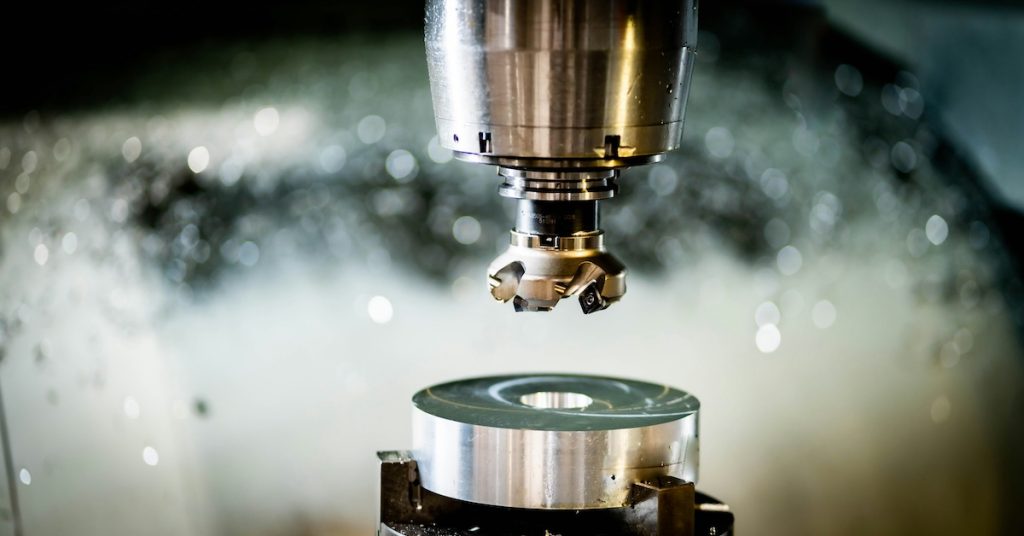
CNC milling ranks among the most common CNC processes. The workpiece remains stationary while rotary cutters move along multiple axes to carve out features, holes, and contours. Multi-axis milling, from 3-axis to 5-axis, allows manufacturers to create highly detailed and multidimensional parts. Eagle Metalcraft’s precision sheet metal forming demonstrates how CNC processes support repeatable precision for commercial and defense applications.
CNC Turning
In turning operations, the workpiece rotates while a stationary cutting tool removes material. The process works well for cylindrical or rounded parts like bushings, flanges, and shafts. CNC lathes produce consistent high-volume output with minimal variation.
Drilling, Tapping, and Hybrid Machining
CNC machines can also perform secondary operations like drilling holes, countersinking, and thread tapping. Hybrid CNC machines go further by performing two types of manufacturing processes, such as milling and 3D printing, or subtractive and additive processes, in a single cycle. This approach reduces setup time and boosts productivity.
Benefits of CNC Manufacturing Services
CNC machining services offer precision and repeatability, ensuring consistent quality across high- and low-volume production runs. They also reduce human error, streamline lead times, and enable complex geometries that traditional machining cannot achieve.
Precision and Consistency
High-end CNC machines can achieve tolerances as close as ±0.0002 inches. Once operators program and dial in a part, the machine can replicate it thousands of times without deviation, making CNC ideal for industries where precision equals safety, such as medical and aerospace.
Scalability and Speed
One of the strongest reasons to invest in CNC manufacturing services is scalability. Manufacturers can accommodate prototypes, low-volume production, and mass manufacturing. Digital files make it easy to modify or repeat designs on demand, allowing teams to respond quickly to changing needs.
Material Versatility
CNC machines can handle everything from aluminum, brass, and stainless steel to plastics and advanced composites. This flexibility allows companies to serve a wide array of industries, including medical, electronics, and military sectors.
Choosing Among CNC Manufacturing Companies
Not all CNC manufacturers offer the same expertise or capabilities. Companies should consider factors like ISO certification, machine types, staff expertise, and past project complexity. For instance, Eagle Metalcraft’s robotic laser welding services highlight its investment in automation and quality assurance, key attributes when selecting a partner.
What to Know
Additionally, look for companies with a proven history in sectors relevant to your needs. Eagle Metalcraft’s work in medical devices manufacturing and ITAR compliance demonstrates its ability to navigate regulated environments and deliver mission-critical results.
Why CNC Manufacturing Matters
What is CNC in manufacturing? It serves as a backbone of today’s precision-driven economy. From rapid prototyping to high-volume production, CNC technologies empower businesses to produce stronger, faster, and smarter. As digital transformation accelerates, CNC machines continue to integrate with AI, IoT, and real-time analytics, creating a smarter, leaner manufacturing ecosystem.
What to Know
To learn more or get started on a custom CNC project, explore Eagle Metalcraft’s full-service capabilities.
FAQ
CNC manufacturing services commonly produce precise parts for industries like aerospace, automotive, and medical. Computer-controlled tools automate machining processes, allowing manufacturers to increase production speed and maintain tighter tolerances.
What is CNC manufacturing?
CNC machining uses computer-controlled machines to remove material from a workpiece and create parts. The process delivers consistent precision and supports manufacturing across aerospace, medical, automotive, and electronics industries.
What does CNC stand for in manufacturing?
CNC stands for Computer Numerical Control. It refers to the computerized automation of machine tools that perform precise, complex machining tasks based on programmed commands.
What does CNC mean in manufacturing?
It means that computer-generated code controls machine tools, enabling high-speed, high-precision manufacturing with minimal human intervention.
What is CNC in manufacturing used for?
Manufacturers use CNC to create parts and components with exact specifications, ranging from surgical implants to aerospace engine parts. CNC also supports both mass production and prototyping.
What two types of manufacturing processes can a hybrid CNC perform?
A hybrid CNC machine can perform both additive manufacturing, such as 3D printing, and subtractive manufacturing, such as milling or turning. This combination allows manufacturers to handle part production and design changes within a single system.