
Sheet metal forming plays a crucial role in creating everything from airplane panels to phone casings. This process transforms flat metal sheets into precise, durable, and lightweight components. At Eagle Metalcraft, our commitment to innovation and craftsmanship drives us to deliver outstanding results in every project.
Sheet metal forming isn’t just about machinery—it’s about understanding material behavior, design intent, and production needs. We blend traditional methods with cutting-edge technologies to deliver accurate parts quickly. With over 70 years of experience, our team excels in producing components that meet tight tolerances.
Industries like aerospace, defense, electronics, and medical devices rely heavily on this forming process. It’s a cost-effective way to create parts with consistent quality and minimal waste. This guide walks you through sheet metal forming, from methods and materials to trends and challenges.
What Is Sheet Metal Forming?
Sheet metal forming reshapes thin metal sheets using force without removing material. This process creates strong, dimensionally stable parts and supports high-volume production.
How the Process Works
The process relies on controlled deformation, allowing manufacturers to shape metal into specific forms while retaining its structural properties. The sheet metal forming process includes methods that shape and cut material with dies, presses, and other forming equipment.
Manufacturers commonly use stainless steel, aluminum, titanium, and copper because of their formability and performance under stress. Metal standards provide additional information about materials used throughout manufacturing.
Sheet thickness often ranges from 0.5 mm to 6 mm, making the process useful for producing brackets, panels, housings, and enclosures with structural integrity. Manufacturers value the technique for repeatability and cost efficiency, particularly in high-volume production environments.
Why Sheet Metal Forming Matters
Sheet metal forming is more than just bending or cutting metal. It’s a strategic process that combines knowledge of material behavior, design engineering, and production systems.
Production Advantages
The process enables manufacturers to produce components that are strong, lightweight, and dimensionally consistent. This is especially valuable in industries where tolerances are tight and performance is non-negotiable.
Companies rely on this process not only to create parts but also to minimize material waste and energy use. From aerospace to telecommunications, manufacturers use forming to build components with consistency, speed, and minimal material waste.
Forming processes can also reduce the need for secondary machining operations, further streamlining production. By leveraging these benefits, manufacturers can improve throughput, lower costs, and achieve greater design versatility.
Core Metal Forming Processes
At Eagle Metalcraft, we use a blend of traditional and advanced forming techniques. We choose each approach based on project specifications, material type, and desired output.
Laser Cutting
Before forming begins, fiber lasers precisely cut flat sheets to create accurate pre-forms and minimize waste. Equipment such as the LVD PUMA 3015 gives the forming process an accurate starting point before bending or shaping begins.
Laser cutting supports both prototyping and full-scale production because it combines speed, precision, and the ability to handle a wide variety of metals.
CNC Brake Forming
Computer-controlled press brakes deliver precision bends with consistent repeatability. This capability is crucial for producing complex brackets and assemblies with exact tolerances.
CNC brake forming automates the bending process, reduces human error, and increases repeatability. It supports a wide range of bend angles and configurations, making it an important part of custom component fabrication.
Deep Drawing
Deep drawing forms seamless, hollow structures like casings or containers by pulling metal into a die. It supports applications in aerospace and medical manufacturing.
The process creates complex, contoured parts without seams or welds, which can improve strength and appearance. Deep drawing requires careful planning and high-quality tooling to reduce the risk of tearing or wrinkling.
Stretching and Rolling
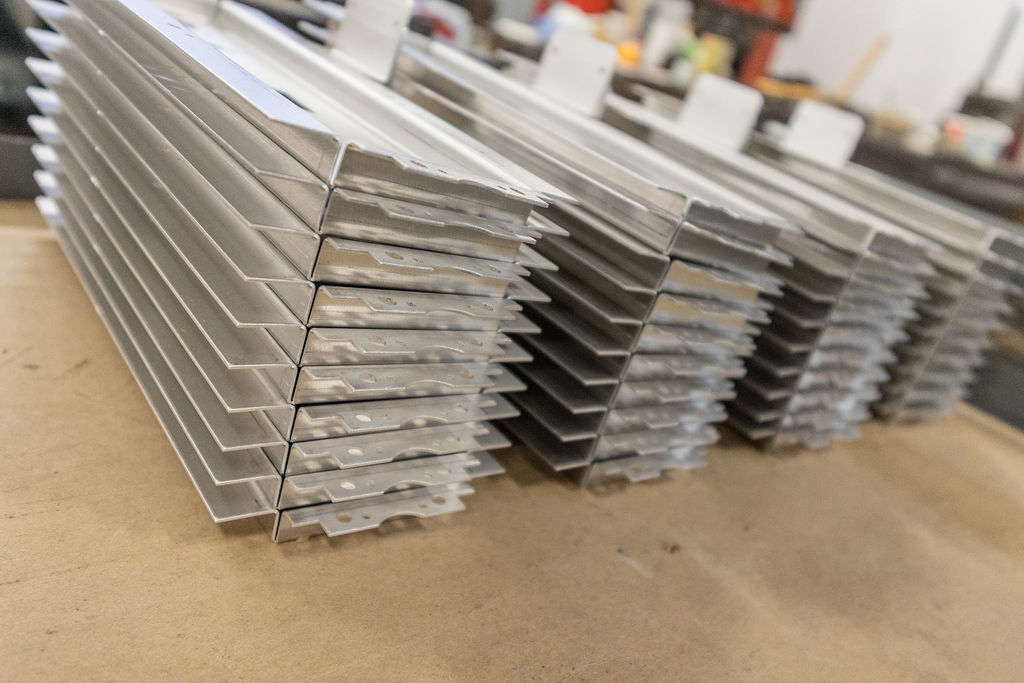
Stretch forming creates contoured surfaces by elongating sheet metal across a die, a method often used in aerospace and automotive applications. Roll forming produces continuous shapes through progressive rolling stages, making it useful for long, uniform profiles such as rails, supports, and channels.
Both methods support projects that require smooth curves and consistent cross-sections, and they complement other forming processes in the workflow.
Assembly and Welding
After forming, manufacturers often assemble components using joining techniques including spot welding, seam welding, and riveting. These methods support structural integrity and long-term reliability.
At Eagle Metalcraft, in-house welding capabilities include manual and robotic systems. Integrating forming, welding, and assembly into one workflow helps maintain consistency from individual parts through completed assemblies.
Equipment Used in Precision Metal Shaping
Top-tier forming requires advanced tools. Eagle Metalcraft uses CNC press brakes, servo-electric benders, fiber laser cutters, robotic welders, and precision dies, jigs, and fixtures to support a range of production needs.
Integrated Production Equipment
Our production floor supports both prototyping and production runs. We also use systems that support data tracking, predictive maintenance, and other smart manufacturing practices.
This integration helps improve productivity, reduce downtime, and improve part traceability while supporting precision metal fabrication.
CNC Press Brakes
Our CNC press brakes deliver accurate and repeatable bends across a wide range of materials and thicknesses. These computer-controlled machines help us maintain tight tolerances, reduce setup time, and automate complex bend sequences.
They support precision components in sectors such as aerospace, medical, and defense.
Servo-Electric Bending Systems
Servo-electric benders offer energy-efficient, clean, and highly controllable forming. Compared with traditional hydraulic systems, servo-driven units can provide faster cycle times, quieter operation, and precise angle control.
These systems work well with lightweight materials and intricate designs that demand consistency and minimal material distortion.
Fiber Laser Cutting Machines
Fiber lasers cut with precision and speed, producing clean edges with minimal waste. These machines handle a broad range of metals and thicknesses, making them suitable for both prototyping and production.
Automation can support continuous cutting with minimal operator intervention.
Robotic Welding and Part Handling
We use robotic systems for high-precision welding and efficient material handling. Robots support consistent weld quality, reduce repetitive manual work, and can improve throughput for larger production volumes.
Information about robotics in manufacturing also highlights applications such as material handling, assembly, welding, and machine loading.
Precision Dies, Fixtures, and Tooling
Custom-engineered dies and fixtures help ensure each part is formed, held, and assembled to specification. These tools support quality across repeated operations, reduce variability, and help manage complex assemblies.
In-house tooling capabilities also give manufacturers greater control over the forming process from setup through production.
Benefits of Metal Forming Processes
Sheet metal forming offers a wide range of benefits that make it an essential process in modern manufacturing. Its ability to produce strong, lightweight, and precise components gives manufacturers flexibility across prototype and production work.
Precision and Repeatability
Sheet metal forming enables the production of components with tight tolerances. Automated systems and well-maintained tooling help each part meet project specifications.
This level of accuracy is especially important in industries like aerospace and defense.
Material Efficiency
Because forming reshapes metal instead of removing it, the process can generate less waste than subtractive methods like machining. This efficiency can lower material costs and support more efficient material use.
Scalability
Sheet metal forming scales from small batches to high-volume runs. Modern forming systems can switch between jobs, making them useful for both prototyping and full-scale production.
Versatility
Forming supports a wide range of part geometries, from simple bends to complex curves. This flexibility allows engineers to design components around performance, weight, and space requirements.
Speed and Automation
Forming processes can require fewer secondary operations, allowing products to move through production faster. Automation also helps manufacturers maintain repeatability as production requirements change.
Challenges in Sheet Metal Forming
Despite its many advantages, sheet metal forming presents technical and material challenges. Manufacturers must account for material behavior, tooling wear, geometry, and process limits to produce accurate parts efficiently.
Material Thickness Limitations
One primary limitation is the material thickness that a particular forming method can handle effectively. Many forming techniques work best within a defined thickness range.
As material becomes thicker, it can resist bending and stretching more strongly, increasing the risk of cracking, incomplete formation, or excessive tooling wear. Engineers must assess part requirements and choose a process that supports both structural integrity and manufacturability.
Managing Material Behavior
Different metals behave differently during forming. Titanium, hardened steels, and certain alloys can present challenges because of brittleness or springback tendencies.
Successful forming requires an understanding of material properties such as yield strength, ductility, and elongation. Heat treatment, lubrication, tooling geometry, and process control can all affect the outcome.
Sheet metal techniques support industries that require strong, lightweight, and precisely formed components.
Springback and Geometric Accuracy
Springback occurs when metal partially returns toward its original shape after bending or stretching. This can create deviations from the intended geometry.
Engineers account for springback in tooling design and machine programming. They may compensate for bend angles, use over-bending techniques, or refine setups through testing to achieve consistent results.
Tooling Wear and Maintenance
Forming tools experience wear over time, especially when working with abrasive or high-strength materials. Worn dies, punches, and press brake tooling can affect part dimensions and increase scrap.
Regular inspection and maintenance help keep forming operations consistent. Manufacturers must balance maintenance needs, downtime, and tooling costs as part of production planning.
Design Constraints
Not every shape or feature works well with sheet metal forming alone. Complex geometries, tight radii, and intricate cutouts may require secondary operations such as machining or welding.
Early collaboration between design engineers and manufacturing teams helps identify these constraints before production. Design for manufacturability principles can help teams balance functional requirements with efficient production.
Industries That Rely on Metal Forming
Sheet metal forming supports a wide range of industries because it combines versatility, precision, and cost efficiency. Manufacturers use the process to create strong, lightweight, and dimensionally consistent components for both specialized and general industrial applications.
Aerospace
In aerospace, sheet metal forming supports structural and aerodynamic components such as panels, brackets, bulkheads, and mounting frames. These parts often require tight tolerances, low weight, and reliable strength.
Techniques such as stretch forming and deep drawing can support these requirements while maintaining repeatability across production.
Medical
Medical manufacturers use sheet metal forming to create surgical trays, instrument enclosures, and diagnostic equipment housings. Stainless steel often supports these applications because of its corrosion resistance and compatibility with cleaning requirements.
Deep drawing and CNC brake forming can produce seamless or accurately formed components with consistent dimensions.
Defense and Military
Defense programs use formed metal for communication housings, equipment enclosures, brackets, frames, and other components that require durability and repeatability.
Forming also supports both production runs and custom fabrication for specialized equipment needs.
Electronics and Telecom
Electronics and telecommunications manufacturers use sheet metal forming for server enclosures, device casings, panels, and other structures that protect internal components.
CNC brake forming and laser cutting help create complex shapes and mounting features while maintaining accurate fit between parts and assemblies.
Industrial
Industrial manufacturers use sheet metal forming for machinery, HVAC systems, vending equipment, enclosures, platforms, brackets, and support structures. The process supports both custom components and repeatable production.
Sheet metal forming continues to prove its value across these industries by supporting consistent production, design flexibility, and efficient use of material.
Trends Shaping the Future of Forming
As manufacturing technology evolves, sheet metal forming continues to adopt new systems that improve efficiency, precision, and responsiveness. Digital integration, automation, advanced materials, and simulation are changing how manufacturers design and produce formed components.
Smart Manufacturing and Industry 4.0
One major development is the integration of smart manufacturing systems. By connecting forming equipment with data platforms through the Internet of Things, manufacturers can monitor machine performance, track part quality, and plan maintenance based on production data.
This approach reflects the broader move toward Industry 4.0 and connected manufacturing systems.
Robotic Automation
Automation continues to expand across material handling, welding, bending, and inspection. Robotic systems can improve consistency, reduce repetitive manual tasks, and support higher throughput.
By integrating robots with CNC-controlled equipment, manufacturers can connect multiple production steps and create more automated workflows.
Advanced Materials and Alloys
Manufacturers continue to use high-strength aluminum alloys, stainless steels, and corrosion-resistant materials where applications demand greater strength, lower weight, or durability.
These materials can require specialized tooling and carefully controlled forming techniques. Manufacturers must adapt their processes to maintain part integrity and finish quality.
Sustainability and Waste Reduction
Manufacturers continue to focus on energy efficiency, scrap reduction, and material utilization. Optimizing part layouts during cutting and forming can reduce material waste, while recycling programs can recover leftover scrap.
These efforts can reduce production costs while supporting more efficient manufacturing operations.
Simulation and Digital Twin Technology
Simulation and digital twin technologies allow engineers to evaluate how a sheet metal part may behave under specific forming conditions before production begins.
These tools can help teams study springback, stress distribution, thinning, tooling, and machine settings before making physical parts. As these systems mature, they can support more informed process planning and faster production development.
Start Your Next Forming Project
Sheet metal forming continues to be one of the most efficient and scalable ways to manufacture custom metal parts. Advanced tools, experienced teams, and integrated production systems help manufacturers move from design into repeatable production.
From Prototype to Production
At Eagle Metalcraft, we bring over 70 years of experience and modern manufacturing technology to each project. From prototype to production, we combine forming with fabrication and assembly to support customers through multiple stages of the manufacturing process.
This integrated approach helps reduce handoffs between suppliers while giving customers one manufacturing partner for precision metal components and assemblies.
FAQ
These questions cover the core concepts, benefits, challenges, and equipment involved in sheet metal forming.
What is sheet metal forming?
Sheet metal forming reshapes flat metal sheets using force without removing material. Manufacturers use techniques such as bending, deep drawing, stretching, and rolling to create finished components.
Why is sheet metal forming important in manufacturing?
The process can produce lightweight, precise components with efficient material use and consistent repeatability. It also supports both prototype work and larger production runs.
What materials are commonly used in sheet metal forming?
Common materials include stainless steel, aluminum, copper, and titanium. The right material depends on the part design, forming method, performance requirements, and production needs.
What are the common challenges in sheet metal forming?
Common challenges include springback, tooling wear, material behavior, thickness limits, and design constraints. Manufacturers address these issues through process planning, tooling design, machine programming, and material selection.
What is springback in sheet metal forming?
Springback occurs when metal partially returns toward its original shape after forming pressure is removed. Engineers compensate for it through tooling design, bend adjustments, programming, and process testing.
How does Eagle Metalcraft support sheet metal forming projects?
Eagle Metalcraft combines forming with cutting, welding, machining, and assembly capabilities to support projects from prototype through production. This approach gives customers access to multiple precision metalworking processes through one manufacturing partner.